MCTA-Accredited Course Date
New Orleans, LA
Upper Quadrant
Saturday, June 27, 2026 — Sunday, June 28, 2026
with Mark Thomson · PT, DPT, OCS, FAAOMPT, CMP, MCTA
Duration
2 days
CE credit
15 CEU hours
Format
80% hands-on
Class size
Intimate
Reserve your seat
From $599
Upper Quadrant · New Orleans, LA
Prefer a lighter option?
Trusted by 5,500+ clinicians
What you'll walk out with
Techniques you'll use Monday morning
Upper Quadrant is built so the skills you learn over the weekend are immediately applicable Monday. Here's the specific edge you leave with.
Same week
Apply MWM in your next clinical session
Lab is interspersed throughout both days — you'll have repped each technique on a real partner under instructor coaching.
Pain-free
Restore motion without provoking the symptom
Mobilization With Movement™ is built to give immediate, measurable change without flaring the patient.
Credentialed
Earn 15 CEU hours
Approved across PT, ATC, and (Upper Quadrant) OT continuing-ed jurisdictions. Credit applies toward your state renewal.
Pathway
Stack toward your CMP credential
Every TCE course counts as a step toward the international Certified Mulligan Practitioner registry.
The curriculum
What you'll learn
- 01
A clinical reasoning framework for application of Mobilization With Movement™ (MWM's) to the cervical and thoracic spines, shoulder, elbow, wrist, and hand.
- 02
Differentiate Mulligan SNAGS, NAGS, and Reverse NAGS in the upper, middle, and lower cervical spines, the CT junction, and thoracic spine.
- 03
Justify MWM selection from history, observation, and patient report.
- 04
Multiple techniques to assess and treat neurosensitivity of the upper quadrant.
- 05
Initiate MWM care based on patient irritability — appropriately intervening with non-weight-bearing to full-weight-bearing functional-movement MWMs. Understand progressions throughout patient care.
- 06
Follow-up HEPs, taping, and advice to help your MWMs stick.
How it's taught
Not a slide deck. A working clinic.
Two-day in-person course. Hands-on lab time is interspersed throughout both days and exceeds 80% of contact hours.
The two-day rhythm
Course schedule
Standard MCTA-accredited rhythm: morning concepts & demos, afternoon labs. Final times confirmed two weeks before the date.
Pre-course Study
Before Day 1
- AnytimePre-course study: video content + required reading
Day 1
- 7:45 AMSign in & registration · Pre-test
- 8:00 AMMulligan theory · guidelines for practical application of Mobilization With Movement™ (MWM's): CROCKS and PILL
- 9:00 AMUpper Cervical lecture: evidence for evaluation and assessment of upper-cervical pain, mobility loss, headaches, and cervicogenic dizziness
- 9:30 AMUpper Cervical lab practice for headache / cervicogenic dizziness and pain / mobility loss
- 10:00 AMBreak
- 10:15 AMCervical demonstration & lab practice: NAGs, Reverse NAGs, SNAGs
- 12:00 PMLunch
- 1:00 PMCervical demonstration & lab practice: SNAGs continued · Self-SNAGs / HEP / Self-management
- 2:00 PMCervical demonstration & lab practice: traction techniques, Transverse SNAGs (Positional SNAGs), Spinal Mobilization with Arm Movement
- 2:30 PMBreak
- 2:45 PMRib & Thoracic demonstration & lab practice: MWM for the ribs and thoracic spine
- 4:30 PMHand demonstration & lab practice: IP, MCP, Metacarpals, Carpals · taping techniques
- 5:00 PMWrist: literature evidence · MWMs · taping · lab practice
- 5:30 PMAdjourn
Day 2
- 7:30 AMReview of key Day 1 concepts and ideas
- 8:00 AMDemonstration & lab practice of MWMs for supination and pronation
- 8:30 AMElbow demonstration & lab practice · HEP · patient self-management
- 10:45 AMBreak
- 11:00 AMShoulder: literature evidence · demonstration & lab practice — Glenohumeral, Acromioclavicular, scapulothoracic MWMs · self-management
- 1:30 PMPost-test and course evaluation
Your instructor
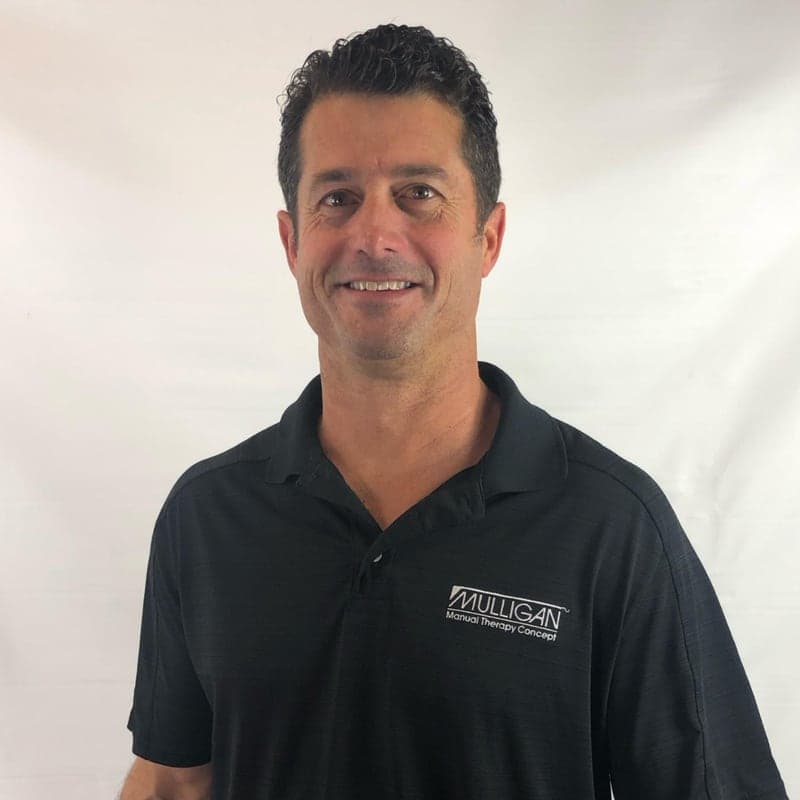
Mark Thomson
PT, DPT, OCS, FAAOMPT, CMP, MCTA
Specialty: 30 plus years experience in Orthopedic clinical practice and 25 plus years teaching, being mentored, and continuous learning have developed Dr. Thomson into an eclectic teacher and practitioner. Mark loves to meet each individual where they are, develop a good rapport, and help them meet their individual goals by whatever means possible. Dr. Thomson enjoys learning and practicing any approach that emphasizes clinical reasoning, continual analytic assessment, and a patient-centered approach. Dr. Thomson earned his B.S. in Physiological Science from UCLA in 1992 and his MPT from UCSF/SFSU in 1995. He graduated from the Kaiser Permanente Manual Therapy Fellowship in Los Angeles in 2000 and earned his tDPT from Temple University in 2005. He is a fellow of the American Academy of Orthopedic Manual Physical Therapists, a Board Certified Orthopedic Clinical Specialist, and an APTA Orthopedic Section member. Dr. Thomson's clinical practice is currently at Kaiser Permanente in San Diego, where he works as a Clinical Specialist treating outpatient orthopedic patients full-time. From 2010–2017 he served as adjunct faculty at the University of Saint Augustine in San Diego within the Physical Therapy Doctoral Program, teaching Spinal Manipulation, Extremity Manipulation, and Orthopedics. He took his first course from Brian Mulligan in 1999 and immediately began applying Mobilization With Movement™ in practice. He completed the Mulligan Concept™ curriculum and became a Certified Mulligan Practitioner in 2004, became an Accredited Instructor in 2014, and from 2016–2024 served as Regional Manager for The Mulligan Concept™ North America.
Clinical specialty
Spinal manipulation, extremity manipulation, and orthopedic manual physical therapy at Kaiser Permanente San Diego.
Where you'll learn
Venue & travel
Venue
New Orleans, LA
Final venue address confirmed by email two weeks before the course date.
Getting here
Travel logistics confirmed by email two weeks before the course date.
Pre-course checklist
What to bring
- Comfortable, layered clothing — you'll be moving and on/off treatment tables
- A water bottle and a notebook (we'll be doing live case notes)
- Closed-toe shoes — you'll be working in the lab the whole second half of each day
- Brian Mulligan's Manual Therapy Textbook (7th ed.) — recommended, not required
- An open mind and a willingness to be both clinician and patient during partner labs
Continuing education credit
15 CEU hours
- Physical Therapists — credits accepted toward state PT continuing-education renewal.
- Athletic Trainers — nationally approved by the BOC; recognized in every state.
- Occupational Therapists — nationally approved by AOTA.
- Counts as one step in the international CMP certification pathway.
Common questions
FAQ
- Is this course MCTA-accredited?
- Yes. Every Clinician Edge course is taught by an MCTA-accredited instructor and counts toward the international Mulligan Concept Teacher Association curriculum.
- Do I need prior Mulligan Concept™ training?
- No. Each course stands on its own. The Introductory course is recommended (not required) for clinicians completely new to MWM, but our Upper Quadrant and Lower Quadrant courses are designed to be solid first exposures as well.
- What if my work schedule changes and I need to cancel?
- We offer a transfer-or-refund window up to 30 days before the course date. Within 30 days we'll work with you to transfer your registration to a future date or another clinician at your clinic.
- Can my whole team attend together?
- Absolutely. Group rates are available for 3+ clinicians from the same clinic. Email us — we'll set you up with a direct invoice and group seating in the lab.
- Will I really be able to use this on Monday morning?
- That's the design intent. Roughly 80% of each day is hands-on lab time with instructor coaching. You'll leave having repped each technique on a real partner — not just watched a slide.
Ready to reserve?
Upper Quadrant · New Orleans, LA
Saturday, June 27, 2026 — Sunday, June 28, 2026 · from $599